
Have you found yourself standing at the tea aisle confused with all the tiny writing on the packages? Understanding how to read a tea label is helpful in a way that it lets you choose a better quality tea and avoid those misleading marketing claims. This is how you make sure that you’re getting exactly what you’re paying for. Tea packaging information is an essential skill if you’re a tea drinker in India. That is so, whether you’re buying everyday CTC tea, premium Darjeeling, green tea or a flavoured blend.
As a tea manufacturer who has been printing, checking and standing behind our own labels since 199, we can help you. We know exactly what goes into that fine print and what it should be telling you. We’ll explain how to read a tea label, what information legally is needed and how you can find quality beyond the attractive packaging in this complete guide.
Quick Stats: Tea Labelling in India
- Tea labelling in India is governed by the Food Safety and Standards Regulations, 2020 which is enforced by the FSSAI.
- Flavoured tea sold in India is capped at a 5% flavouring limit and it needs a separate registration with the Tea Board of India.
- Every compliant label has to carry a 14 digit FSSAI licence number along. Non compliance can lead to fines of up to ₹3 lakh.
- Staple pins in tea bags have been banned in India for consumer safety.
Sources: Food Safety Mantra | Velco Legal India
How to Read a Tea Label in 6 Simple Steps?
Step 1: Check the Tea Type
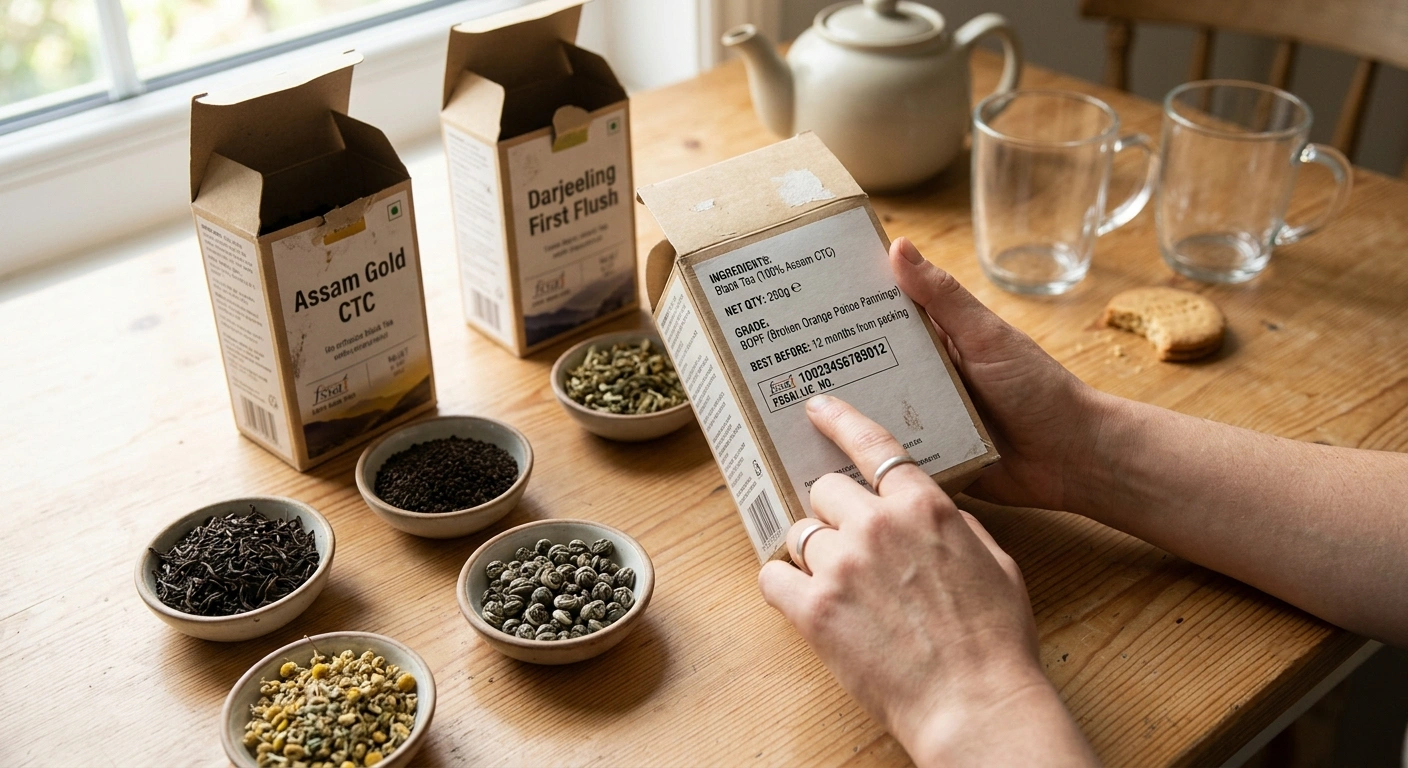
Start with the basics and check if it is a black, green, white, oolong or a herbal blend. Black tea is the one that dominates all Indian households and has labels that usually indicate one of two processing styles. First is the CTC tea (Crush, Tear and Curl), which gives the strong and quick brewing cup most people drink daily. Second is the orthodox tea, where the leaf is rolled with less mechanical processing for more of a delicate and nuanced cup. By knowing the type, you know what to expect before you’ve even opened the pack be it the strength, brewing time or the flavour profile.
Step 2: Look for the FSSAI Licence Number
Every packaged tea that is being legally sold in India must display a 14 digit FSSAI licence number. This is mandatory under the Food Safety and Standards Authority of India’s regulations. This number confirms if the brand is a registered Food Business Operator. You can verify it on the official portal of FSSAI if you want to double check a product’s authenticity. A missing or invalid licence number is a serious red flag. The same regulations also carry penalties of up to ₹3 lakh for non compliance.
Step 3: Read the Ingredient List
Ingredients have to be listed in descending order by quantity, with allergens being highlighted in bold under the Food Safety and Standards Regulations, 2020. If you see natural flavouring substances listed, the tea has been flavoured and FSSAI rules cap that flavouring at a maximum of 5% of the product. Any suspiciously short ingredient list that you see on a heavily marketed premium blend could be a red flag. If you see any vague wording like just “flavour” with no extra detail, it is worth a second look before you buy.
Step 4: Verify the Origin or Estate
Keep in mind that words like Darjeeling, Assam or Nilgiri should mean something specific. But it’s also true that not each and every label backs the claim with full detail. A trustworthy single origin tea label is going to name an actual estate or garden instead of a broad region. The more specific the claim is, the more it is worth trusting. Country of origin labelling is legally mandatory for all the imported tea. So if a pack claims to be a foreign speciality tea, then this line should confirm where it actually came from.
Step 5: Check Certifications
Look for an ISO certification like an ISO 22000 beyond the FSSAI number. This means that the manufacturer follows a formal food safety management system. Check for a reference to Tea Board of India registration if the tea is flavoured. This is because flavoured tea manufacturers are legally required to register their flavouring formulation with the Tea Board before they sell it. None of these guarantee a taste on their own. But they’re a solid proxy for a serious brand which is about the compliance and ethical sourcing.
Step 6: Check the Manufacturing and Best Before Dates
All compliant label have to state the net quantity in metric units and not just that, but along with a clear best before date and the full name and address of the manufacturer or brand owner. These details matter more than it may look like. Any missing manufacturer address is a big red flag. This is the case because legitimate tea manufacturers in India have to be legally transparent the product you’re drinking and who actually made it. A fresh best before date is also important as it tells you that the tea hasn’t been sitting in a warehouse losing its aroma before it reached the shelf.
What Every Tea Label Should Include
Label Element |
Why It Matters |
| Tea Type | Tells you what you’re buying |
| Grade | Indicates leaf size |
| Ingredients | Reveals flavourings |
| Origin | Confirms sourcing |
| FSSAI Number | Legal compliance |
| Net Quantity | Product comparison |
| Batch Number | Helps identify production batches |
| Dates | Freshness |
| Manufacturer | Traceability |
| Net Quantity & MRP | Helps compare value |
| Storage Instructions | Preserves tea quality |
Common Tea Grades You’ll Find on Labels
Tea grading can look like a wall of confusing abbreviations but it’s more than that. It just simply describes the leaf size and style instead of the quality on its own. Here’s a quick reference for the grades that are most commonly printed on Indian tea labels:
Grade |
Full Name |
What It Means |
| FOP | Flowery Orange Pekoe | Whole leaf and orthodox, includes tender leaf tips |
| OP | Orange Pekoe | Whole leaf, orthodox, long and wiry |
| TGFOP | Tippy Golden Flowery Orange Pekoe | High grade orthodox with golden tips. They are common in premium Darjeeling |
| BOP | Broken Orange Pekoe | Broken leaf and brews faster. They are stronger than whole leaf |
| BP | Broken Pekoe | CTC grade and larger broken particles |
| PF | Pekoe Fannings | CTC grade, smaller particles strong quick brewing cup |
| PD or D | Pekoe Dust or Dust | Finest particles and are common in tea bags for a fast and robust brew |
As a rough rule, keep in mind that: orthodox grades like FOP, OP and TGFOP are related to single estate and speciality teas. And grades like BP, PF and PD are made for everyday chai and tea bags. This is where strength and consistency matter a lot more than leaf appearance.
Red Flags to Watch Out For
There are certain labelling practices that deserve healthy skepticism, such as “100% organic tea” without certification marks, “preservative free” with preservative codes listed in the ingredient list, fancy labels without any mention of origin, grade or estate. It is also worth considering the absence of manufacturer information, illegibility of the “best before” date or net quantity in odd units, since these have been mandated by FSSAI regulations. This does not necessarily mean that the tea is bad; it is just something to reconsider before spending extra money on it.
How Alexa Tea Labels Reflect Transparency
Alexa Tea is a tea manufacturer sourcing from the Himalaya, Assam, and Darjeeling since 1993. We treat our own labels the same way we’d want a customer to read them, clearly, honestly and with nothing hidden in the fine print. Each of our packs carry verified FSSAI details along with accurate ingredient listings. There is clear origin information that you can actually trace back to the gardens we work with.
Alexa Tea is here to help whether you’re launching your own private label tea brand or even sourcing premium loose leaf tea in bulk. We provide compliant packaging, transparent ingredient declarations along with a complete labelling support. Our team lets you bring high quality tea products to market with confidence.
Conclusion
Learning how to read a tea label is one of the easiest ways you can become a smarter tea buyer. Avoid depending on the attractive packaging or any of the marketing buzzwords. Take a few moments to go through the tea type, ingredient list, origin, certifications, FSSAI licence number, manufacturing details along with the storage instructions. These details reveal a lot more about the tea than the front of the pack ever actually will.
Frequently Asked Questions
-
How do I read a tea label to check for quality?
A – Knowing how to read a tea label for quality means checking the tea type and grade. Look for a valid FSSAI licence number along witha an ingredient list for added flavourings. And see if the origin claims name a specific estate rather than a vague region.
-
What does the FSSAI number on a tea label mean?
A – The 14 digit FSSAI number confirms that the product is legally registered as food for sale in India. It means that it can be used to verify the licence status of the manufacturer.
-
What is the difference between CTC and orthodox tea on a label?
A – CTC tea is processed by crushing, tearing and curling the leaf. This is done for a strong and fast brewing cup. A orthodox tea uses less mechanical processing and it preserves more of the natural character of the leaf.
-
Is single origin on a tea label always accurate?
A – Not always, a trustworthy single origin claim mostly names a specific estate or garden. And any vague regional descriptions without more detail may simply be the marketing language.
-
What information is mandatory on a tea label in India?
A – All the Tea labels sold in India need to include the product name, ingredient list, net quantity, FSSAI licence number, manufacturer details, batch number, manufacturing or packing date, best before date, MRP and other declarations. This is mandatory under the Food Safety and Standards Regulations, 2020.