
If you just walk down any tea aisle in India today, you may see two very contrasting promises on the label. One may read like “Darjeeling Single Estate” or “Assam Orthodox” and it is more about one garden and a season. The other may read like “Premium Blend” or “Classic Chai”, which is where you are promised a familiar cup of tea that has been sourced across regions. Now, this single-origin vs blended tea debate is actually much more than just this packaging language. It reflects how just how different these two philosophies of tea making are. Understanding it can change the way you shop, brew and even run your tea business.
Single-Origin vs Blended Tea: Quick Stats
- The country exported 254.67 million kg of tea in 2024 in which premium and single-origin variants contributing very significantly to the increased demand worldwide.
- The total sales of premium Indian teas, which include single-estate and artisanal teas, exceeded 15,000 metric tons in 2023 because of the increased demand for origin-specific tea in urban areas.
- Single-origin tea can cost 50% more than blended variants, mainly owing to their lower production and rareness based on the terroir factor.
- The total Indian tea industry’s value was estimated to be USD 11,702.3 million in 2024 and was expected to experience steady growth till 2033.
Sources: IMARC Group – India Tea Market Report | Reports and Data – Single Origin Tea Market (International Tea Committee data)
What Is Single-Origin Tea?
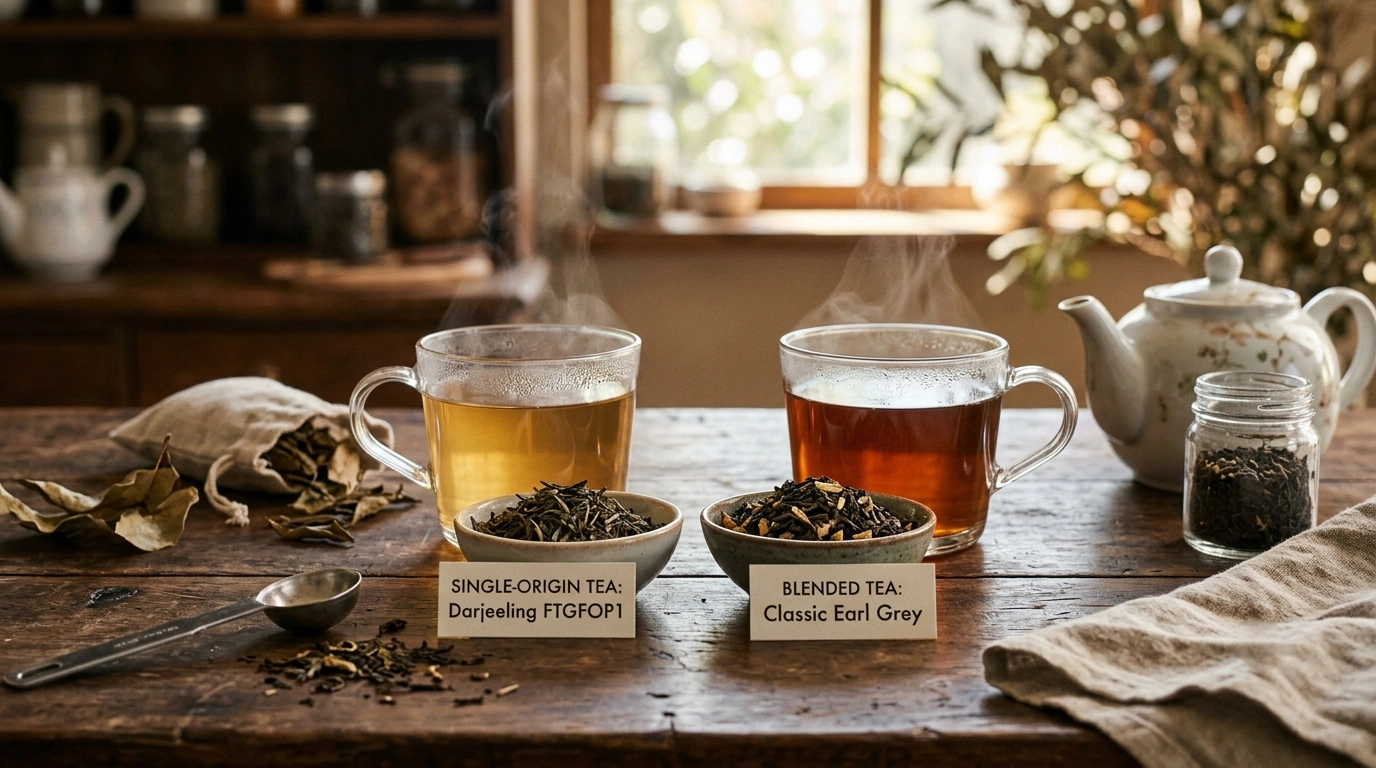
Single-origin tea has a single source and is derived from a particular geographical location, usually a single country, or more commonly, from a single region, garden, tea estate, or even flush. Estate tea is another name used for this kind of tea. An example of a single-origin tea from India would be the first-flush Darjeeling from a particular garden located in the foothills of the Himalayas. As the tea is not a blend and contains only tea from a single location, the taste is entirely based on the soil conditions, elevation, rainfall and processing method, which tea producers refer to as terroir. This is why the taste of a Darjeeling single-estate tea is very uniquely floral and muscatel. And an Assam origin from the Brahmaputra valley is more bold, malty and full-bodied. The contrast between these two is very noticeable even though both are grown in India itself.
These teas are more likely to be sold as whole leaf tea or even a loose leaf tea. This is so since the intact leaf preserves the delicate character which defines the harvest of the specific garden.
The trade-off is variability. This is because each of the harvest reflects the specific weather and growing conditions of the season. The character of any single-origin tea can slightly shift year to year which is a part of its appeal for connoisseurs.
What Is Blended Tea?
Blended tea is made using leaves from various gardens, different regions or even harvests to create a certain flavour profile. Famous blends such as English breakfast tea or the base for masala chai are always blended using a tea taster who tweaks the ratio of component teas annually to adjust for any natural variation. Blends mostly draw on CTC tea, which is Crush, Tear, Curl, for strength and colour. These are sometimes combined with orthodox tea processing for the depth of flavour. If the base is black tea, green tea or even white tea, the manufacturer can balance balance strength, aroma and body from different sources into a cup. It is supposed to taste the same no matter if you buy it in Punjab or Kerala, in January or July.
This is an art in itself. Blending a tea has really nothing to do with covering up the low grade leaves. It’s more about combining premium tea and speciality tea grades from different tea gardens into something more consistent. For example, when a region produces poor quality leaves, what the blender does is is that they increase the share of a stronger tasting origin to balance out the end product.
What Are The Key Differences Between A Single-Origin vs Blended Tea?
Factor |
Single-Origin Tea |
Blended Tea |
| Source | One garden, estate or harvest | Different regions or harvests combined |
| Taste | Distinct and region specific character | Balanced, familiar and crowd pleasing |
| Aroma | Unique to the estate and flush | Consistent and made for repeatability |
| Consistency | Differs by the season and harvest | Consistent year round |
| Availability | Limited, seasonal and mostly scarce | Widely available and year round supply |
| Price | Mostly higher and up to 50% more | More affordable and everyday pricing |
| Best Brewing Style | Light steeping without any milk to showcase terroir | Strong brewing and is well suited to milk tea and chai |
| Milk Compatibility | Best enjoyed without any milk | Excellent with milk and spices |
| Traceability | Fully traceable to one estate | Traceable to a blend recipe and not a garden |
| Wholesale Suitability | Niche for premium retail and gifting | Perfect for bulk, hospitality and private label |
| Seasonal Variation | High and changes with each flush | Low and actively managed by the blender |
How to Choose Between Single-Origin and Blended Tea?
The right choice actually depends on how and why you’re really buying the tea:
Choose single origin tea if: you want to explore tea terroir, enjoy tea tasting as a hobby, gift something valuable or have particular first flush or second flush Darjeeling or Assam estate tea.
Choose blended tea if: you intend to consume tea regularly with milk and spices, want consistency in taste and price or are shopping for a household, cafe, or office where consistency is preferred over seasonality.
Choose blended tea if you’re a business: hotels, cafes, and retailers who source it from a wholesale tea supplier that guarantees supply through blending and not relying on one particular estate’s harvest quantity, which will be limited.
Consider private label tea: Brands that want their own identity in the market normally begin with the blends, as a private label tea partner can replicate the formula in batches.
Check the grading and leaf type: If full flavour is what you require then you should go for whole leaf tea or loose leaf tea with a well defined tea grading label like whole leaf orthodox or CTC grades.
Does It Actually Matter? Which Is Better for Indian Tea Drinkers?
Neither one is a better choice here as it all actually depends on what you really want from your cup. When one is sampling their teas like a connoisseur samples single vineyard wines, then there is nothing better than a single origin Darjeeling or a particular Assam garden tea. For someone who wants consistency, the best thing is a blend, which ensures that each cup brewed is the same as the previous one. The latter method is what most of the Indian families prefer for their tea.
Blended tea is also beneficial for enterprises like hotels, cafes and offices providing tea because it helps to overcome one important challenge: ensuring a consistent supply of product. The tea from a particular garden may be influenced by the monsoon season or high temperatures that year, but the blend from different areas does not.
Price, Availability and Quality Considerations in India
Price is another thing that differs the most between these two. Given that single origin tea is based on a particular garden’s limited production, and the fact that scarcity increases the price, market statistics show that there is a 50% higher price for single origin tea compared to blended tea. The situation is made worse in India owing to the weather challenges faced in growing areas such as Darjeeling and Assam. That’s where erratic rainfall and rising temperatures can limit a specific origin availability in a given season.
Blended teas provide consistent prices and availability, since the blender can change or modify the composition as necessary. The consistent quality of blends is especially useful for consumer usage and caterers in India, hence the reason why blends prevail in mass market channels, whereas pure varieties are found in the premium and speciality markets. This does not imply that blends are of inferior quality, as a well-selected blend always uses orthodox or CTC whole leaf variety. It only implies that the focus moves from the unique characteristics of the particular origin to consistent strength, color and taste of the beverage. When dealing with a tea exporter or tea supplier, this consistency often becomes the decisive criterion.
How Alexa Tea Sources Both Single-Origin and Blended Tea
As one of the well-established tea brands in India, having a legacy since 1993, Alexa Tea operates in both traditions, offering tea drinkers in India the right tea for the right occasion:
Single-estate sourcing: We source directly from well-established tea gardens in Himalaya, Assam and Darjeeling regions, so that those seeking a particular distinctive regional tea have the true single estate tea, including various first flush and second flush varieties.
Expert blending: Our tea testers create daily blends of black and green teas sourced from different regions into consistent blends such as Gold Tea, Elaichi Tea, Royal Tea and Masala Tea.
Batch-level quality checks: No matter whether it is single origin or blended, every batch undergoes testing for taste, aroma and colour. We follow the same tea grading principles which we use in our black tea manufacturing process.
Bulk, private label and wholesale flexibility: Hotels, cafes and retailers can either offer their customers speciality single estate tea lines or purchase tea from Alexa Tea as a wholesale tea supplier and private label tea brand.
Shop the single-origin and blended tea collections from Alexa Tea. Contact our team for bulk sourcing now.
Conclusion
Whether tea is better made as a single-origin or blended depends on which aspect is more important to you. It could be the unique identity of a particular Indian tea garden and harvest or a reliable and comforting combination of teas. They actually are equally relevant to the way Indians drink tea. There are options like the estate tea Darjeeling or a masala chai blend that make mornings happen every day of the week. We source and craft both of them with equal care at Alexa Tea,
FAQs
-
What’s the difference between single-origin and blended tea?
Single-origin tea is produced in one particular garden, region or even in a particular harvest; however, blended tea involves leaves sourced from different gardens or harvests to provide uniform taste.
-
Is single-origin tea better than blended tea?
Not really, Single-origin tea provides a unique taste determined by the terroir which varies depending on the seasons; blended tea guarantees a uniform taste year round.
-
Why is single-origin tea more expensive than blended tea?
It is because of the limited supply of single-origin teas which can only be harvested at one particular time from one particular garden. It has been proved industry-wide that single-origin teas may be even 50% more expensive than blended teas.
-
What are examples of single-origin Indian tea?
Darjeeling first flush tea from a specific estate as well as single estate Assam tea are great examples of Indian single-origin tea, valued because of their unique taste associated with the particular area.
-
What is the difference between CTC tea and orthodox tea?
CTC tea goes through the process of crushing, tearing and curling of leaves, while orthodox tea goes through the process of whole leaves or lightly rolling of leaves without breaking the leaf.
-
Does Alexa Tea sell both single-origin and blended tea?
Yes. Alexa Tea offers single-estate teas from the Himalaya, Assam and Darjeeling regions as well as professionally blended teas such as Gold, Elaichi, Royal and Masala.