
Walk into any cafe today and you’ll see it: a bright green, slightly foamy drink-one or two dollars more than a traditional green tea latte. Matcha has officially attained the status of the “health” beverage du jour, from Frappuccino’s and ice cream to box drinks and body scrub. Is it truly radically different from the green tea your using for years or is it just glossier marketing in lime green packaging?
We at Alexa Tea are frequently asked about the differences. In short, here are the differences in cultivation, processing, brewing and their effects on nutrition and caffeine-all the while ending with a definitive answer on the worth of the matcha premium.
What Is Matcha, Really?
Believe it or not, both regular green tea and matcha are produced from the same plant, Camellia sinensis. The key distinction is in the manner in which the plant is cultivated and processed prior to being brewed.
Several weeks prior to harvesting, matcha plants go under shading from direct sun light – most commonly using bamboo mats or fabric screens. This lack of direct sunlight causes leaves to develop higher concentrations of chlorophyll, giving matcha its brilliant bright green color. The shading in addition causes the juices of the leaves to develop higher concentrations of amino acids, such as L-theanine, noted for inducing a calm mental alertness.
Following harvest, the leaves are steamed, and then air dried, de-veined and de-stemmed. What is left, tencha, is ground down by stone-mills to a fine powder. That is matcha.
Standard green tea, on the other hand, is full sun grown, picked, steamed or pan-fired, rolled, and then dried into whole or broken leaves. When you brew, you infuse the leaves in hot water and throw them away.
The Key Difference: You Drink the Whole Leaf
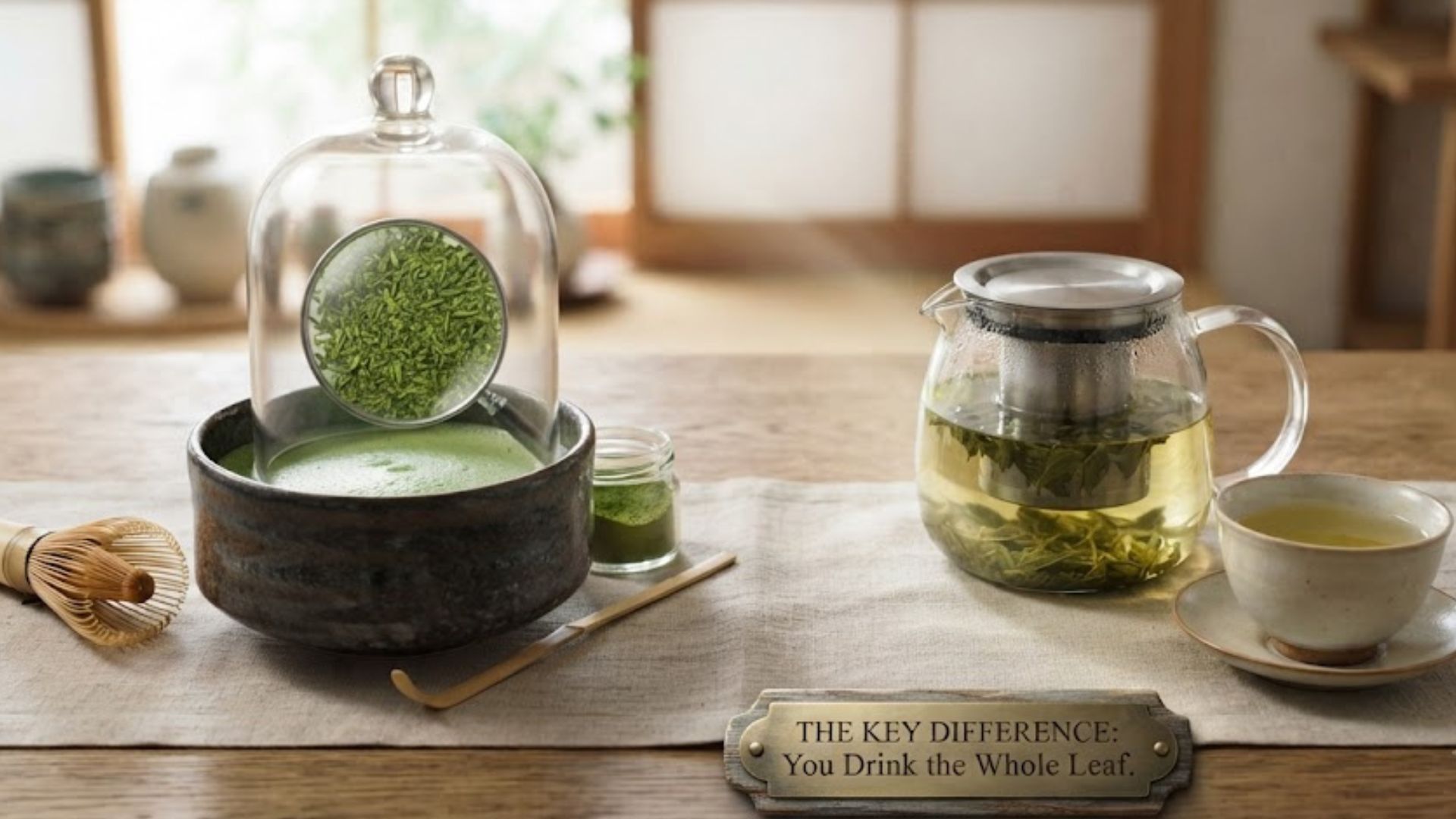
This is by far the biggest difference between the two. When you drink ordinary green tea, you are drinking a water-soluble extract of the leaf. When you drink matcha you are whisking the entire powdered leaf into a glass of water and drinking the lot.
Matcha provides a higher concentration of nutrients, antioxidants and caffeine per serving because you are consuming the entire leaf, not just the extract from steeping. This is where most of the health benefits of matcha arise.
Comparing Nutrition and Antioxidants
Green tea contains catechins, a group of antioxidants thought to be useful for the heart, functioning and cell protection. The most docu mented catechin is EGCG (epigallocatechin gallate).
Since it is a powdered green tea and one ingests the whole leaf while preparing it, researchers have shown that matcha is found to have considerably higher amount of catechins and EGCGs in higher concentration than when a cup of green tea is prepared by steeping the green tea leaves. As per some researches; it is said that matcha can potentially provide 3 to 5 times higher antioxidant potential per cup than when brewed like a typical green tea.
Matcha also usually contains an elevated level of L-theanine due to its shade-grown cultivation. This amino acid is said to be responsible for the “calm energy” that matcha provides-focused alertness without the nervous energy some people get from drinking coffee.
Caffeine: Matcha Packs More Punch
An eight ounce mug of normal green tea will have anywhere between 25-45milligrams depending on brew time and the quality of the leaves. Matcha contains more caffeine because you eat the whole leaf so it will usually be more along the lines of 60-80 milligrams per mug although this can vary depending on grade and amount used.
This is one reason why people often use matcha as a way to eliminate coffee but still get that kick of energy. Thanks to the combination of caffeine and L-theanine, the body experiences a more even-paced energy boost than with coffee.
Flavor and Preparation
Fresh green tea has a wide range of flavor nuances, from grassy and vegetal to nutty or mildly sweet, depending on the type of leaves used. It is very easy to brew: just add leaves to hot water and wait a few minutes, then strain out the leaves.
Matcha Green has a more robust taste than other green teas. It tends to be umami-flavored and quite bitter to taste and becomes smooth when whisked properly. To make real matcha, one needs to sift the powder twice to get rid of big clumps, pour in hot but not boiling hot water and whisk vigorously in a zigzag motion with a bamboo whisk or chasen for about 20 seconds, forming a small layer of foam at the top.
Another reason matcha costs significantly more than the average steeped tea is the additional (and optional!) step of transporting it whisked with hot water into a milk or so. This is also probably why it makes such a fantastic ingredient for both lattes, smoothies and baked goods-dry matcha slides seamlessly into all kinds of liquid and batter without a problem, unlike steeped.
Price: Why Does Matcha Cost More?
Matcha is a lot more work than a regular cup of green tea. Growing, shading, plucking, de-veining and destemming tencha, and finally stone-grinding into a fine powder all take time and care. The younger, more tender the leaves, the more expensive the matcha, with ceremonial grades being top dollar and culinary grades more affordable.
While regular green tea production is a little easier, as the end result generally is less expensive, very good single origin green teas are similarly costy. On the other hand, it is not always best to use the cost as criterion to choose the better tea.
So, Is Matcha Worth the Hype?
The truthful answer: it depends on what you want.
Opt for matcha if: you’re looking for a more potent source of both antioxidants and caffeine, you appreciate a smoother, umami-packed taste, and you are okay with a slightly higher price tag or some extra effort in making.
Opt for standard green tea, when you like a subtle taste that changes from cup to cup, need less caffeine, or are happy to check out easier ways to brew and buy another cup.
Yes, both of these teas do give real health benefits, and yes they both come from the same wonderful plant. Matcha is not some miraculous superfood, and drinking plain green tea isn’t some far inferior substitute. They are, in fact, both different expressions of the same leaf, perfect for different palates, routines and times of day.
Try Both and Decide for Yourself
Here at Alexa Tea, we think the only way to settle the matcha vs. Green tea argument is to try and taste the difference yourself. Browse our carefully chosen collection of ceremonial grade matcha tea, and our best loose-leaf green teas, and discover which one is worthy of a permanent place in your daily routine.
With whichever you decide, you’ll be enjoying a beverage that has been brewed and perfected for centuries, complemented by genuine health benefits and packed with flavor.
Conclusion
Both matcha and regular green tea are made from the same plant, but because they are processed differently there are differences in nutrients, caffeine and flavor. Matcha is a concentrated source of antioxidants and delivers smooth, sustained energy, whereas green tea is a lighter and easier to brew option. Neither is necessarily better than the other; it all comes down to taste, your body’s needs and your daily ritual.
Here at Alexa Tea we always urge our customers to try both and really work out which one is best for them.
Matcha deserves some of the hype, but green tea is a timeless, dependable classic.
Frequently Asked Questions
Is matcha healthier than regular green tea?
More concentrated antioxidants and nutrients are present in Matcha since you are drinking the whole leaf. Even brewed green tea provide good health promoting benefits are just in smaller, dilute quantities.
Does matcha have more caffeine than green tea?
Yes, a cup of matcha usually has 60-80mg of caffeine compared to 25-45mg in normal green tea. This is because you are consuming the original powdered leaf itself rather than an infusion.
Can matcha replace coffee?
A lot of people use matcha as an alternative to coffee. The amount of caffeine, along with the L-theanine in it, gives you energy over a longer period of time without the crashing and jitters from coffee.
Why is matcha more expensive than green tea?
Instead, it involves growing them under shade, meticulously hand-harvesting and plucking them, removing the stems and grinding them to a powder, stonegrinding them into an even finer powder. And this process takes more money than simply steaming and rolling green tea leaves.
What’s the difference in taste between matcha and green tea?
Matcha has a deep, umami, somewhat bitter, rich flavor with a creaminess to it. With regular green tea the flavor varies much more, from grassy and vegetal to nutty or slightly sweet with the selection of varietals available.
How do you prepare matcha versus green tea
Make matcha by sifting the powder, adding hot water and whisking to a frothy consistency. Green tea involves adding loose leaves to hot water and leaving for a few minutes before removing.
Is ceremonial-grade matcha necessary for everyday drinking?
No, ceremonial is preferred for traditional preparation, and for drinking directly. Culinary grade can be substituted with delicious result in lattes, smoothies, and baking for a lower price and higher yield.
Which is better for weight management, matcha or green tea?
Both have catechins associated with helping the metabolism. The difference might be an advantage (Matcha has more catechins) but overall nutrition and regular activity will overshadow what kind of tea any single person consumes.